
The presence of the cardinal’s hat and an early version of the Cesarini family’s heraldic symbols allows us to confidently identify the frescoes commissioned by Alessandro. We find the Bear tied to the Column, on which stands an Imperial Eagle with outstretched wings, the same eagle that many will ‘see’ in the unusual shape of the Castle.
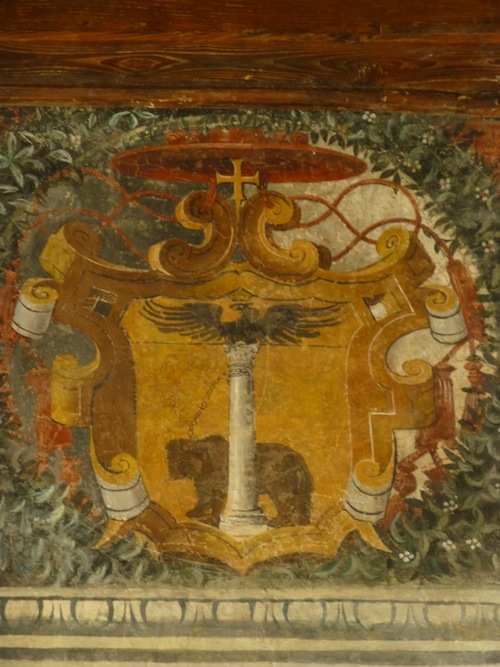
The coat of arms of Cardinal Bishop Alessandro Cesarini
The themes are classic ones of pictorial cycles intended to exalt the patron and his family: mythological scenes, historical narratives, battles, medallions of heroes, grotesques. The references to Roman history, as seen through the eyes of Titus Livius, are significant: the war between the Sabines (we are, after all, in Sabina) and the Romans, the fire that destroyed the Temple of Vesta, the ‘Romanness’ of the trophies of arms and warriors. It should be remembered that the Cesarini family claimed direct lineage from Julius Caesar, a claim that supported their support for Charles V of Habsburg. The friezes are not homogeneous. In some rooms on the piano nobile, the frescoed bands appear as narrative panels punctuated by caryatids, trophies of arms, monochrome warriors, and grotesque inserts. In others, the friezes are continuous, and the narratives unfold seamlessly. Following a stylistic approach reinforced by Mannerism, the frieze had no beginning or end, thus expressing the unlimited, immortal time of the patron and his family. This totemic and mythical function negated History. The frescoes in the cycle associated with Giuliano Cesarini’s commission are recognizable by the presence of the joint Cesarini-Colonna coat of arms. Giuliano had married Giulia, the daughter of Prospero Colonna, in a lavish wedding, and their scenographic apparatus had been designed by Baldassarre Peruzzi. But the difference lies not only in the coat of arms. Roman Mannerism had already exploded for two decades, and some of its stylistic characteristics are present in the frescoes: the “acid” colors, the truncated figures, the paradoxical or incongruous juxtapositions, the crowding of objects and entities on “flat” pictorial surfaces devoid of perspective rationality, the hybrids of species and gender.

The joint Cesarini-Colonna coat of arms
The theme of metamorphoses culminates in Giuliano’s cycle. Ovid becomes the central reference. A patient reading of the friezes identifies numerous episodes from the Metamorphoses: Narcissus at the fountain (III, 435-503), the abduction of Proserpina (V, 385- ), Europa abducted by the bull (VI, 104- ), Bacchus discovers Ariadne (VIII, 152-180), Perseus, Andromeda and the dragon (IV, 665-740) and others. But everywhere in the frescoes the mythological and hagiographic references are translated into depictions of hybrids and figures in transition, the jumbles of fragments seek complete forms but do not yet find them, the grotesques and ornaments add their ‘monstrous’ caprices. Ongoing and never-ending change becomes the dominant iconic pattern. A chaos of fragments and bizarre objects – inert things and living entities – are represented as they try to become recognizable forms, precise species and genera, complete bodies. It is the beginning of De rerum natura, but also more simply the first verses of Ovid’s Metamorphoses. The frescoes in the Rocca, and even more so the Giuliano cycle, seem to be the realization of Ovid’s program: « In nova fert animus mutatas dicere formas / corpora »: « It is my purpose to sing the transformation of bodies into other new bodies ». The aesthetic representation (poetic, pictorial) serves to tell the story of the birth of these new bodies from the « discordant germs of not well harmonized substances » [I, 9]. The frescoes are a narrative that unfolds with some uncertainty from one room to another, from one frieze to the following. They tell the story of the transition from chaos to order through the enlightened action of the patron as organizer of the world and creator of its forms.

Fresco. Victoria in clipeo scribens, 1538-1548
One must resist the temptation of a historical and political interpretation. The Sack of Rome dates back to 1527. The pro-imperial Cesarini had purchased the protection of their Roman palace from the Spanish with 40,000 ducats, but one week later the Spanish themselves announced they could not stop the Landsknechts’ sacking, and the Cesarini immediately fled the city. The frescoes express the disorder of present times and the hope for a restored world order epitomized by rich figures and strong forms: catastrophic change brought under aesthetic control and steered toward a structured outcome. The frescoes are not a political tale, they are a family eulogy. They tell how the chaos of the world finds is restored through the Cesarini. The same narrative is conveyed by the new Castle, a grandiose synthesis of opposites (palace/fortress), things (the castle) and totem animals (eagle? scorpion?), a full fledged hybrid like the stories of hybrids in Ovid’s Metamorphoses.